


The Truth About Cover-Up Tattoos — A Conversation with Ivo Angelov
Updated: Sep 13
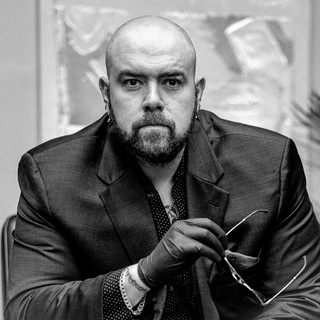
Ivo Angelov is a black and grey realism tattoo artist at Cherno Ink in Huntsville, Alabama. Cover-ups are a huge part of what walks through his door — old names, faded tribal, pieces from artists who quit the trade. We sat down and asked him everything people ask in his consultations. He didn't sugarcoat any of it.
Let's start simple. Someone has an old tattoo they hate. Can you just put a new one over it?
Yes — but not the way most people imagine. Inks don't magically cover other inks. When I tattoo over an old piece, the new pigment doesn't sit on top like paint on a wall. It goes into the skin and blends with what's already there. So the whole job of a cover-up is planning around that reality: what's dark stays dark, and I have to build a design where that darkness belongs.
So what actually covers an old tattoo?
Opaque pigments. There are two ways to do black and grey. The classic way is solid black diluted with water — 80, 60, 40, 20 percent — and your own skin works as the light tone. It's beautiful, but it's translucent, so it can't hide anything. Then there are opaque greys: actual black and white mixed into a solid color. No translucency, full coverage of the skin. That's what does the heavy lifting in a cover-up — there's a fuller explanation of opaque versus classic black and grey if you want the technical side. That, plus composition — the trick is a game of shadows. I'm distracting your eye from what used to be there.
What kind of designs work best?
Bigger, bolder, darker. Battle-worn things are gold: cracked helmets, weathered stone, warrior faces with scars, ravens, lions, skulls. Anything with texture and darkness gives me places to hide the old tattoo inside it. What doesn't work: bright imagery, fine-line detail, tiny lettering, or a perfect smooth angel floating over your old piece. People ask me for that one a lot. The answer is no — and it's not me being difficult. A cover-up needs a darker image. That's just how the physics of ink in skin works.
Be honest — do cover-ups ever need more than one session?
Assume yes. There's no percentage on this, and I've stopped quoting one. Either you need a second pass or you don't, and most of the time you need it, almost every time. What it really comes down to is how much you want to go again, and how okay you are with whatever is there right now.
The second pass is usually a half day, once everything has settled: three months at the earliest, and by eight months you're seeing the real result. Old lines can peek back through even good coverage. That's not a failed cover-up; that's a normal cover-up. There's no magic "go over it once and done." Anyone promising you that is promising you the stars and the moon, and that's just not good practice.
Those dramatic before-and-after photos on Instagram, though...
That's the part nobody tells you. A fresh cover-up photo is the immediate effect — fresh ink sitting in the top layer of skin, looking flawless. Great for Instagram. But that's not the product. The product is three to five months later, when the skin has healed and become homogeneous, and you see what actually stayed. That's the tattoo you live with. So I judge my cover-ups at the three-month mark, not on day one — and if something needs another iteration, we do it. My name's on that tattoo.
People often think their old tattoo has "faded enough" to be easy to cover. True?
Tattoos don't really fade. The body very rarely discharges the pigment — instead, new skin grows over it, and the ink spreads a little as cells break down and get absorbed, which is why old tattoos look blurry and soft. But the ink is still down there. If you scraped the surface layers away, that tattoo would look like it was done yesterday. So "it's faded" usually just means "it's blurry" — the darkness I have to cover is all still in the skin.
What about covering scars?
Very doable, with the same logic. A scar on its own draws the eye; put it inside the right composition and the pattern becomes the distraction. Around a scar I can get detailed; on certain spots — like directly on the kneecap — I keep things bolder and more solid, because some skin just doesn't hold fine detail. If the design calls for darkness right where the scar is, it can disappear almost completely. Nobody's looking for a scar inside a piece of art.
A lot of people shop around on price for a cover-up. What's wrong with that?
Everything, and I'll tell you exactly why. A tattoo is a t-shirt you can never take off. If you could only wear one t-shirt for the rest of your life, would you buy the cheapest one at Walmart, or would you buy a really nice one? Nobody sane picks the cheap shirt. But when it comes to tattoos, people haggle — and what they're haggling for is the cheapest possible product to wear for the rest of their life.
With cover-ups it's worse, because the mistake compounds. Someone price-shops a cover-up, doesn't do their homework, and ends up with something worse than what they started with. And now it's twice as hard to cover up a cover-up. I've seen it plenty. The cheap decision is the one that costs the most in the end.
What does a cover-up cost with you?
Same structure as all my work: I book full days and half days. A full day is $1,700, a half day is $900, and most cover-ups are a full day. Booking takes a $500 deposit that goes toward the price of the tattoo — here's how the deposit works and why I'm adamant about it. If a second pass is needed months later, that's usually a half day, and small touch-ups on my work I handle under what I call my warranty: if something pushes out, come back, I want to fix my tattoo.
Last question. What should someone do before coming to see you about a cover-up?
Come in. That's it — cover-up consultations have to happen in person, because I need to see the tattoo: how saturated it is, how your skin healed, what your skin tone gives me to work with. I can't quote a cover-up from a phone photo and I won't try. Bring your ideas — AI-generated concepts are welcome, they get the picture out of your head — and then let them go through my prism, because my job is to tell you what will actually work ten years from now, not just what photographs well next week. Consultations are free and walk-in at Cherno Ink, Thursday through Sunday, 12 to 5:30. Worst case, you leave with an honest answer.
Have an old tattoo you're ready to say goodbye to? Book a free consultation or see cover-up work from the chair.


Comments