


How a Cover-Up Tattoo Gets Designed — A Conversation with Ivo Angelov, Part 2
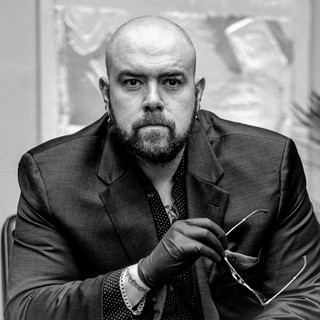
In Part 1, Ivo Angelov laid out what a cover-up can and can't do. This time we asked about the part nobody sees: what actually happens when someone sits down in his chair at Cherno Ink with an old tattoo and a picture on their phone. Every answer below is what he tells clients in the consultation. We just wrote it down.
Someone walks in with an old tattoo and an idea on their phone. What's the first thing you look at?
Not the phone. The tattoo. How saturated it is, where it's darkest, how your skin took it and what your skin tone gives me to work with. Because the whole design hangs on one rule: the darkest part of the new tattoo has to sit on the darkest part of the old one. The centerpiece has to be the darkest thing in the piece. Everywhere around it is free game. You can draw almost whatever you want out there. But that center isn't negotiable, and it's usually what changes the picture on the phone.
Why can't the new design just have open space in it? A cross with clean skin inside, say.
Because inks don't magically cover other inks. New pigment doesn't sit on top like paint. It goes into the skin and blends with what's already there. So anything empty in the new design, the negative space inside a cross, inside a heart, is going to be a color, because the old tattoo is behind it. There's no way for it to be blank. And once one gap in the design gets a tone, every gap has to get the same tone, or it looks blatantly like a cover-up. That's why an old piece pushes me toward designs with no holes in them: crests, shields, helmets, skulls. Things with texture everywhere.
You say "bigger" a lot. Clients must hear that as an upsell.
I know, and I'll say it straight: this is not me asking you to do more rather than less. I'm being realistic about what's on your skin. Here's the honest version. Say you want a specific object. A client came in wanting a particular warplane over an old solid-black piece. If I fit the whole plane over the old tattoo, the old tattoo pokes out on the sides. So I stretch the plane to catch the edges, and now the plane is huge. It's a puzzle: the more I try to fit it in there, the larger the thing becomes. And a plane lives in the sky or on a tarmac, so unless I'm drawing a runway down your arm, mopping up the leftovers with clouds looks ridiculous.
What actually works is cropping in. A close-up of the nose, shark mouth and all, big and bold, with the darkness exactly where I need it. The elements get bigger, so the coverage gets better, and it's a stronger tattoo. That's not more tattoo for the sake of it. That's the only version that works.
People want their kids' names, a date, a verse. Can lettering go in a cover-up?
Yes. Just not on top of the old tattoo. Small lettering barely works on bare skin: the font is so small it dilutes in the skin, and in a couple of years it shifts and blurs. Over an old piece it has no chance. Same with tiny detail. I don't want to be descriptive on a cover-up, sitting there with a small needle packing little squares and hoping they heal perfect. That works great on empty skin. Over something black, it doesn't.
So the names go where I have clean skin. A scroll or a band next to the piece, a shield under the helmet, above the heart on the calf. A scroll is paper, it has to read lighter, so it has to live on bare skin. And don't just slap words onto an image. That's oil and water. Lettering has to be built into the composition, not stuck on afterward.
Which is why the finished tattoo is always bigger than the one it replaces, on purpose. The old tattoo gets the dark centerpiece. The bare skin around it gets the detail and the lighter stuff. A small ram on a calf turns into a crest, a cross and scrolls that take the side of the leg. Could I do just a shield in the middle? Sure, that's a half day. But building it bigger is what I'd go for, because the bigger the object, the better it hides what's underneath, and the less it reads as a cover-up.
What do you turn down?
A full-body figure over a big old piece, a whole warrior standing on your old tattoo. If you had a little blip, I can do that. Over what most people bring me, no. Crosses with light rays: it's very bright, and I can't hide anything behind light. A smooth, perfect face, a clean angel, a pretty face with no shadow in it. Tribal and realism in the same piece: a tribal Jesus is oil and water.
And sometimes the image is a great cover-up but wrong for the spot. The face of Christ carrying the cross covers beautifully, but I've done a lot of them, and it'd be strange in the middle of a family piece. So I'd rather build you a crest or a shield. Crests are saturated, full of filigree and incrustation, darker in texture. Texture and darkness, that's what I need to warp something in there. I would rather say no and not take your money than have something bad out there with my name on it.
What's the hardest cover-up you see?
A cover-up of a cover-up. Somebody already tried once. In a photo you can barely see it; in person you can definitely spot the old wording, the dagger. Stuff bulks out through the second tattoo. It looks better than it was, but it isn't covered. Now I'm covering both. It's doable, but it's exactly why I tell people not to price-shop the first one.
Walk me through the second session. Is it a touch-up?
No, and I've stopped calling it that. A touch-up comes and goes in thirty minutes: something pushed out, I fix it, you don't pay. My work comes with that warranty. A second pass on a cover-up is different. It's almost a full pass through the big blocks of grey, re-packing the opaque colors so the old tattoo goes quiet. That's a half day of me sitting down, and it's priced as a half day. I used to call it a touch-up and give it away. I stopped, because it isn't one.
Here's the timeline. A tattoo heals in two to three months. The first weeks it peels, then the skin stays a little shiny until it settles. Three months is the earliest we can judge it. By eight months it's really settled, and that's the best time to look. Somewhere in that window you come back, we look at it in person, and we decide together. There's no percentage on this. Either you need the second pass or you don't, and most of the time you need it, almost every time. What it really comes down to is how much you want to go again, and how okay you are with whatever is there right now. Everybody's skin is different, different pH, different hormones, different healing, and that's what decides how much pokes back through. If it's a small piece and only a corner peeks out, that's ten minutes and I won't charge you.
Any places on the body you treat differently for a cover-up?
Hands and knuckles don't heal as well as the rest of you, and I tell you that up front. And if the tattoo you want covered or fixed is fresh, I'll make you wait. A piece that's a few weeks old needs about two more months before we can see what actually stayed in the skin. Right now it's shinier than the skin around it. Working on it early just hides the flaws until they come back.
What if someone doesn't need a full cover-up, just a fix on a tattoo that's off?
Then I'm probably not your artist, and I'll tell you so. I book full days and half days, nothing less. If your skeleton hand has the bones stopping short of the wrist and needs them extended, a deeper shadow at the knuckles and some white so the bone shines, that's a small job. I'm not going to charge you nine hundred dollars for a half day to fix something small. I'll look at it, tell you exactly what's wrong, and hand you to an artist here who does that kind of work, and I'll explain to her what needs to happen. Some artists are great at some things and not at others. That's true of me too.
Last one. What do you need from the client to make a cover-up work?
Work with the artist. Bring your ideas, AI images, screenshots, whatever gets the picture out of your head, and then let them go through my prism. When I say the object needs to be bigger or darker, that's not me being difficult. That's me knowing what the tattoo looks like once it's healed. You'll see several designs on the day, we'll move things around together, and when the stencil goes on, speak up. That's the moment. It's your tattoo, but it's my tattoo too. My name's on it.
Ready to bury an old tattoo? Read Part 1 if you haven't, then book a free consultation or see cover-up work from the chair.


Comments